

Abu Rahat Murshed Kabir, UK
For decades, atheists, secularists, and freethinkers in Bangladesh have lived with a quiet, constant fear. To reject religion, to question faith, or to speak openly against religious extremism in a Muslim-majority society is not merely a personal belief. In Bangladesh, it has too often been treated as a crime, a provocation, or even a death sentence.
Atheism in Bangladesh is not simply a philosophical position. It is a political identity forced upon individuals by a society and a state that increasingly allow religion to be weaponized. Over the last fifteen years, Bangladesh has witnessed a horrifying pattern of targeted killings, intimidation, forced exile, censorship, and state failure to protect those who do not conform to religious orthodoxy. The current political environment under the interim Yunus regime has deepened these dangers, with extremist forces finding new space to operate and intimidate.
This is not a theoretical debate. It is a matter of life and death.
The Historical Context: Secularism Betrayed
Bangladesh was founded in 1971 on principles that included secularism, democracy, and social justice. The Constitution originally enshrined secularism as a core state principle. Yet over time, political compromises, military regimes, and opportunistic alliances with religious parties weakened that foundation.
Successive governments allowed religion to seep into law, politics, and public life in ways that gradually normalized the idea that faith, rather than citizenship, defines legitimacy. What began as symbolic concessions eventually became structural changes. Islamist groups, once marginal, gained influence. Blasphemy-style thinking, even without formal blasphemy laws, became culturally enforced through mobs, threats, and social pressure.
Atheists, humanists, and secular bloggers emerged in the 2000s and early 2010s as a new generation of voices. They wrote about science, rationalism, women’s rights, LGBTQ+ issues, and religious hypocrisy. Their goal was not to attack believers, but to challenge fundamentalism and promote critical thinking. For this, they were marked for death.
The Blogger Killings: A Message Written in Blood
From 2013 to 2016, Bangladesh became infamous for a series of brutal murders of secular bloggers and atheists. Men armed with machetes hacked writers to death in their homes, on the streets, and in public places. The victims included Ahmed Rajib Haider, Avijit Roy, Washiqur Rahman, Ananta Bijoy Das, Niloy Neel, and others.
These killings were not random. They were targeted assassinations carried out by extremist networks linked to Ansarullah Bangla Team, Ansar al-Islam, and affiliates of al-Qaeda in the Indian Subcontinent. The killers justified their actions as punishment for “blasphemy” and “insulting Islam.”
International organizations, including Human Rights Watch, Amnesty International, UNESCO, and the Committee to Protect Journalists, repeatedly warned that Bangladesh was failing to protect secular voices. In some cases, victims had sought police protection and were ignored. The message to atheists was clear: the state could not, or would not, keep them safe.
The psychological impact was devastating. Many writers fled the country. Others went silent. A culture of fear replaced open debate. Atheism, once discussed cautiously, became something to hide entirely.
Criminalizing Thought: Law as a Tool of Silence
Even when not physically attacked, atheists in Bangladesh face legal harassment. Laws relating to “hurting religious sentiments,” cyber security, defamation, and public order have been used to intimidate critics of religion. The mere allegation of offending religious feelings can trigger arrests, mob threats, and social ostracism.
This creates a form of soft blasphemy law. The state does not need to formally criminalize apostasy or atheism when mobs and vague laws do the job. The result is the same: suppression of freedom of thought.
International human rights law, including Article 18 of the ICCPR, protects the right to freedom of thought, conscience, and religion, including the right not to believe. In practice, Bangladeshi atheists are denied this protection. Their identity is treated as provocation.
The Yunus Interim Regime: Extremists in the Opening
The fall of Sheikh Hasina’s government in 2024 and the rise of the interim administration under Muhammad Yunus was initially welcomed by many as an opportunity for democratic renewal. However, for atheists and secularists, the situation has become more dangerous, not less.
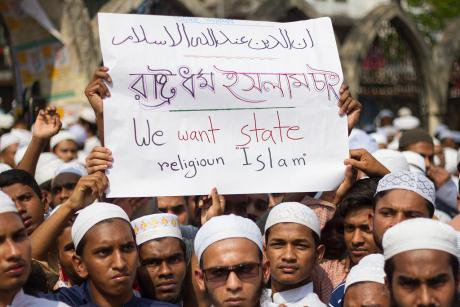
Multiple human rights and media reports indicate a rise in communal violence, attacks on minorities, and growing space for Islamist groups. Reports also suggest the rehabilitation or normalization of previously marginalized Islamist political actors, including Jamaat-e-Islami and allied networks. This shift has sent a dangerous signal: extremists are once again legitimate political players.
Recent reporting highlights thousands of hate incidents against religious minorities and a broader climate of impunity under the interim government. Rights groups have criticized the administration for failing to curb mob violence and for allowing radical groups to exert influence over institutions.
For atheists, this environment is particularly terrifying. When the state appears weak, divided, or willing to appease religious hardliners, extremists interpret it as a green light. The lesson of the past is clear: whenever political Islam gains space, atheists are among the first targets.
Atheism as a Political Crime
In Bangladesh, atheism is rarely treated as a private belief. It is framed as a political betrayal, a foreign conspiracy, or an attack on national identity. Atheists are accused of being “agents of the West,” “anti-Islam,” or “enemies of the people.” This rhetoric dehumanizes them and makes violence seem justified in the eyes of extremists.
Social media has amplified this danger. Death lists, doxxing, and online threats are common. Atheists are publicly named, accused, and marked. Once a name circulates, physical danger often follows.
This is not just about religion. It is about power. Extremist groups use religion to control speech, silence dissent, and impose ideological conformity. Atheists threaten that control simply by existing and thinking freely.
The State’s Moral Failure
Perhaps the greatest tragedy is not the existence of extremists, but the repeated failure of the state to confront them decisively. Every time a blogger was murdered, officials promised investigations. Some arrests were made. But the broader climate of intimidation remained unchanged.
A state that truly believes in secularism does not ask writers to “be careful” with their words. It does not advise people to hide their beliefs for their own safety. It does not allow mobs to act as informal religious police.
Yet this is exactly what has happened. The burden of safety has been placed on victims, not on perpetrators. This is a moral and legal failure.
Why This Matters Beyond Atheists
The persecution of atheists is not an isolated issue. It is a warning sign for society as a whole. When a state cannot protect those with unpopular beliefs, no one is truly safe. Today it is atheists. Tomorrow it may be journalists, women’s rights activists, political dissidents, or minorities.
Freedom of thought is the foundation of all other freedoms. Once that collapses, democracy becomes an empty word.
The Choice Before Bangladesh
Bangladesh stands at a crossroads. It can either recommit to its secular constitutional values and protect all citizens regardless of belief, or it can continue sliding toward a model where religion dictates who deserves safety and who does not.
The Yunus interim regime has a historic responsibility. It can either confront extremism with clarity and courage, or it can allow it to grow in the shadows. Silence and appeasement will not bring stability. They will only embolden those who believe that machetes, mobs, and threats are acceptable tools of “moral correction.”
Conclusion: To Exist Without Fear
Atheists in Bangladesh are not asking for special treatment. They are asking for the most basic right any human being can claim: the right to exist without fear. The right to think. The right to speak. The right to live.
A society that cannot tolerate disbelief is not confident in its faith. A state that cannot protect unbelievers is not confident in its laws.
The treatment of atheists is a test of Bangladesh’s moral and democratic integrity. Right now, that test is being failed.